


[vc_row rt_row_background_width=”default” rt_row_style=”default-style” rt_row_borders=”” rt_row_paddings=”true” rt_bg_effect=”classic” rt_bg_image_repeat=”repeat” rt_bg_size=”cover” rt_bg_position=”right top” rt_bg_attachment=”scroll” rt_bg_video_format=”self-hosted”][vc_column rt_bg_image_repeat=”repeat” rt_bg_size=”auto auto” rt_bg_attachment=”scroll”][vc_column_text]
There are some managers still thinking that Supply Chain or Operations are the enemies of Sales. They think that the goal of those areas is just reducing costs what would mean to deteriorate the firm service level, and finally that would negatively affect customer satisfaction and sales. However, a few management tools as Balance Scorecard show clearly that there is a positive link between back office processes and the customer perspective. Thus, leading firms are able to demonstrate this positive direct relation between Supply Chain Management and Sales.
What is Sales Efficient Supply Chain Management (SESCM)?
To be successful in the fierce competitive marketplace, it is not enough having a good Sales or Operation strategy any more. Nowadays we need both synchronized strategies with a powerful synergistic effect that allows market leader firms to beat the market. This is what we could call Sales Efficient Supply Chain Management (SESCM.)
Are Sales and SCM opposite views of the company?
Someone could be still thinking that Sales and Supply Chain are not really “enemies” but “opposite” views of the firm (front-office vs. back-office). Nevertheless, the origin of logistic is likely one of the 4 Ps of marketing, I mean Placement. So the main logistic objective is satisfied customers delivering the right products, the right quantity, with the right documentation, in the right place, at the right time, with the right packing, and to the right customer. In addition, Supply Chain goal is to improve customer performance attributes (reliability, responsiveness and agility.) Also, it should improve internal performance attributes (cost, and assets) or at least to maintain an acceptable competitive level on those internal attributes. Thus, we could say that Sales and Supply Chain Management are not necessary opposite views of the firm rather than complementary views with the same goal of customer satisfaction.
How do leading organizations implement Sales Efficient Supply Chain Management (SESCM) strategies?
Uncoordinated Sales and Supply Chain areas just drive companies to mediocrity. On the other hand, a well-coordinated Sales and SCM areas can bring huge operational benefits AND sales growth. That is the result of success Sales Efficient Supply Chain Management (SESCM) strategies. Let’s go to review a few examples of SESCM strategies to get a better understanding:
- ROLLS-ROYCE Power System (MTU do Brasil) stock reduction program. MTU do Brasil was in a complicated distressed turnaround situation where it needed to improve cash flow and profitability quickly. Thus, a few SESCM initiatives were put in place. First, overstock reduction with discount campaigns. Second, write off obsolete stock to improve the warehousing process and the stock costs (cost of capital, damage, insurance, obsolescence, and shrinkage), AND being able to build stock on the reference that customers really need. Third, implementing a make-to-order scenario for preventive maintenance (overhauls) based on collaborative planning with customers, which reduced the stock need it for those services and the transportation cost. Moreover, with better planning we got to serve better customers (improving the reliability of Delivery On Time.) We must stress that service is a Key Success Factor for future sales. Fourth, stock transfer to customers searching for additional discounts. So we avoid extra cash needs to finance a few growing projects, offering special discounts to customers willing to build some stock. Those discounts supported sales growth, AND that stock in the customer side reduced the KPI of Equipment Downtime accelerating the services to customers AND improving the company cash flow.
- CADBURY implementation of minimum order size. This initiative could mean inflexibility and lack of customer orientation. The implementation result could have the risk to lose sales from customers who prefer smaller orders and more frequent deliveries. Indeed, the result was very positive. From the logistics point of view there was a cost saving because the number of shipments per year were reduced, and the size of the shipments were increased. From the sales point of view this initiative pushed customers to purchase just a little additional quantity, the supermaket shelves showed more product attracting better customer attention, and reducing the sales lost for out of stock (during unusual high sales days, delivery delays, transport strikes, etc.) Finally, retails realized that their handling costs were reduced AND sales were growing. So the initiative were working well for all the stakeholders.
- ZARA/INDITEX supply chain strategy to produce and distribute in small batches. Small batches make raising production and distribution cost, but it allows Zara to avoid overproduction costs, minimize inventory, and reduce unsold products return. So at the end the advantages were higher than the disadvantages. Traditional approaches would say that small products batches generated stock-outs, fewer sales and unhappy customers. Nevertheless, this lean approach “is pushing” Zara customers to buy quickly because if they delayed the purchasing decision, next visit to the store could be late to find that product any more. Additionally, Zara customers used to visit Zara stores more often than visit competitors’ ones because they know that Zara bring new products in small batches almost every week.
- MERCADONA Spanish Supermarkets stopped selling references that could not sell at least one unit in all their network of supermarkets every day. This initiative could generate customers defections who are loyal to some brands that they will not able to find in Mercadona anymore. Nonetheless, this initiative increased supermarket profitability per sqm because of the increase of references turnover, reduced the complexity of handling many references, and increased the purchasing power of Mercadona with the remaining ones. Sales did not fall down because customers are more loyal to Mercadona high quality service than brands from manufacturers. Many customers had to change their initial products preference to Mercadona owned brand, but Mercadona brand is much cheaper and with “similar” quality what increased customer satisfaction and loyalty. Moreover, this approach increased supermarket contribution margin while competitors were reducing the selling price and their margins to stop sales drops due to the Spanish economy slowdown (from 2011 to 2014).
- IKEA business model based on transferring supply chain activities to customers to get lower selling prices. Many managers think about increasing the number of services to increase sales and profit. But Ikea realized that transferring some activities to customers as pick, load, ship and assemble products would get a better value chain configuration for customers. The new value chain improved selling prices what it is a Key Success Factor to increase sales and profitability. Additionally, handling disassembled furniture for inbound logistics is bringing an important stream of cost savings on inbound transport and storage.
- TOYOTA production system (lean manufacturing). Lean manufacturing is based on reducing the 8 wastes (overproduction, waiting, transportation, overprocessing, inventory, movement, making defective product, and knowledge disconnect). This approach challenges the traditional approach based on “over production and over stock to serve customers better.” So Toyota implemented this production system what optimized its supply chain reducing the 8 wastes AND delighted customers with high quality products at reasonable cost. The result was that Toyota achieved the world biggest car company position.
- DELL make-to-order strategy for mass customization. During long time was assumed that firms building stock could offer immediate product availability, and would be able to close sales easier. But what about customer customization? Dell showed us that make-to-order is a very profitable strategy because with almost ”zero stock,” they can avoid the huge costs related to stock AND customized products to customers’ needs. Thus, Dell was able to offer a very customizable product at competitive rates (Internet disintermediation effect was another KSF) what increased their sales importantly.
- CHEVROLET Spain (Daewoo motor at that time) quick market entry by logistics outsourcing. We could think that because market entry is an important decision, outsourcing logistics could not be the appropriate entry strategy (one of the disadvantages of outsourcing is “losing control”). However, Chevrolet/Daewoo successfully materialized all the advantages of a logistics outsourcing strategy (cost reduction, flexibility, complexity reduction, etc.) AND they could focus on developing the non-existent dealer network. Moreover, the logistics investments avoided by outsourcing supported extra sales and marketing initiatives to make the brand awareness faster. So there was operational cost saving, AND sales growed quickly.
- UBER cost advantage of drivers and cars iddle time to beat the market. This firm offers around 30% cheaper prices than traditional taxis, AND much better service because it is more secure this service than taxis driver (this is an important differentiator in some countries where security is an issue like Brazil), vehicles have and use air conditioner (underdeveloped countries have an important amount of taxis without AC, and in developed countries they have AC but drivers many times decide to switch off to save fuel), the customer service is better (Uber vehicles have sweets, water, and service is evaluated after trips to guarantee the best service level). But how can Uber offer better service and cheaper rates? Uber has a SESCM strategy in place based on taking advantage of assets/cars and driver iddle time. So many drivers are working for Uber because they are unemployed or as a second job for extra income because they have some free time and their vehicles too. Furthermore, Uber application supports drivers to get more services and improve their service turnover compared with traditional taxis. This offer Uber a cost competitive advantage that is using to attack taxi business with lower rates.
Some of the above SESCM examples redefined completely the firm value chain, and that strategy used to be the essence of their company business model (for example IKEA SESCM strategy). Furthermore, in those success business models growth mean profitability, because profits growth faster than sales due to operational efficiencies that limited overheads’ growth at the same rate (Eg. Zara/Inditex).
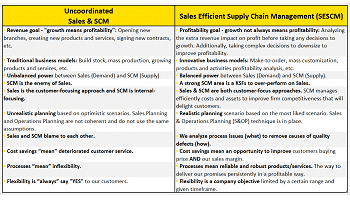
Uncoordinated Sales & SCM versus Sales Efficient Supply Chain Management (SESCM)
[/vc_column_text][vc_single_image image=”3454″ img_size=”full” alignment=”center” title=”Uncoordinated Sales & SCM vs. Sales Efficient Supply Chain Management (SESCM)”][vc_column_text]
In turnaround situations, we used to find uncoordinated Sales and SCM areas which blame to each other. Implementing SESCM strategy is not an easy job, but these initiatives can really turnaround the firm performance and profitability. Exploring lean techniques is a good initial point to find Sales Efficient Supply Chain Management strategies.
Barriers to implement Sales Efficient Supply Chain Management (SCEM)
The higher handicap to implement Sales Efficient Supply Chain Management (SESCM) is getting a CEO which background is quite unbalanced to Sales or SCM side. I mean CEO should have a complete vision and understanding of all areas of the firm. The CEO should have the skill to think out the box and find strategies in which Sales and Operations have a synergetic effect rather than uncoordinated strategies which sum is zero. The conservative CEO is unlikely to get advantage from SESCM because he/she used to replicate traditional and low risk strategies. SESCM strategies need well-prepared, imaginative and courageous leaders who realized that copying the strategy of the industry leader is a losing battle.
[/vc_column_text][vc_cta h2=”Looking for a Turnaround or Transformation?” h2_font_container=”font_size:20x|color:%23000000|line_height:24x” h2_use_theme_fonts=”yes” shape=”square” style=”flat” add_button=”right” btn_title=”request a visit” btn_style=”flat” btn_color=”theme_style_2″ btn_align=”right” btn_i_align=”right” btn_i_icon_fontawesome=”fa fa-angle-right” use_custom_fonts_h2=”true” h2_link=”||” btn_link=”url:http%3A%2F%2Fc2024.strategok.com%2Fcontact%2F||target:%20_blank” el_class=”third_bg_color” btn_button_block=”true” btn_add_icon=”true” css=”.vc_custom_1470319838897{padding-right: 20px !important;padding-left: 20px !important;}”][/vc_cta][/vc_column][/vc_row]