


[vc_row][vc_column][vc_images_carousel][vc_column_text]
Without a good football team, league cannot be won; without good professors, university cannot get well-trained students; with the wrong staff, a company or department cannot deliver good results. So creating high performance teams is an important key success factor for any team.
We could use many characteristics to define what a high performance team is. Although, I would suggest reducing to a couple of them: vision and execution. Some authors mention other dimensions like alignment, influencing, relationship building, and so on. However, we can consider that those characteristics are implicit into the two main ones mentioned.
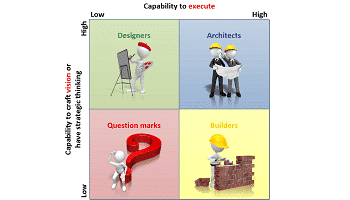
Classification of team members
[/vc_column_text][vc_single_image image=”1276″ img_size=”full” alignment=”center” title=”Classifying Team Members”][vc_column_text]
Question marks
Those people do not have the capability to vision, neither to execute according to their current position for the project/department/firm. Many teams underperform because they have a few questions marks; they are not able to move them to other quadrant or out the project/department/firm. Firms’ objective should be having zero questions marks. We are reviewing two main problems regarding performance in “question marks”:
- Aptitude: If the problem is aptitude, the solution could be training. Unfortunately, sometimes we have workers that even receiving training they are not able to assimilate it. That is the situation of staff that is not ready for the current position. Moreover, very technical profiles without “almost any managerial education” when they are promoted wrongly to managers can create the situation of losing a good technician and having a bad manager. However, the worst aptitude situation is when the worker has important qualification gaps to perform his jobs, but he is not able to be conscious of his limitations.
- Attitude: If the problem is attitude, the solution could talk about that with the employee expecting a new and positive attitude in the short-term. Unfortunately, many times change attitude is a very difficult task.
Builders
Those people are not visionaries, but they execute activities assigned well and on time. When we are talking about people that manage teams, builders align and support teams in order to execute activities properly. Companies need many Builders to do things happen.
Designers
There are specific teams like marketing that this profile is very worthy because they just perform creative tasks. On the other hand, we have visionaries and/or creative people in positions that execution is extremely important. In that situation they have problems executing because they do not like day to day tasks, or they do not know how to transform the vision into tangible and measurable initiatives and tasks. So people with execution problems must be learnt quickly to focus on delivering results (what is quite difficult to get), change the positions, or unfortunately “get out of the bus” (out the project/department/firm). Organizations used to need many fewer designers than builders.
Architects
This is more complex and unusual profile (having vision and execution capabilities in the same person). Those people used to be the leaders of the organization because they know where must go and they materialize it. Most of the top management staff should have this profile. These very high performance people used to search for high performance members in their teams. When we do not have good people at the top, it is difficult to get right and motivate people downstream.
Key Sucess Factors to create high performance teams
- Perform a good selection process. If the decision was wrong, we must correct the mistake in a few months rather than in a few years.
- Analyze team members (see the team members’ classification)
- Coach the team.
- Offer feedback to team members.
- People with aptitude and/or attitude problems that “cannot be solved” must be replaced for “the right people.”
- I have to stress some “obvious” but common thing; we should not maintain people in the team just because they are nice, funny and so on. But at the same time we should not “get out the bus” people that we just do not like but they are good performers.
Creating a high performance team is not an easy task. We are going to try to do great things with normal people, but sometimes we are realizing that apparently normal people are “not very normal” (we cannot get tasks assigned properly done; even it is worst, future tasks will likely have problems too). In many occasions team members are a consequence of past wrong decisions, and unfortunately sometimes the “only” solution is “getting out the bus some passengers”. That is the most difficult and unpleasant task for any manager, but sometimes training, speaking, etc. are not solving the performance problem. “Getting out the bus” solution is not enough used in many underperformed teams especially in times that firms are achieving “enough” results. Many companies wait for “bad times” to execute unpleasant tasks, and that time could be late and even put in risk the company and all the jobs (e.g. many turnaround situations).
[/vc_column_text][vc_cta h2=”Looking for a Turnaround or Transformation?” h2_font_container=”font_size:20x|color:%23000000|line_height:24x” h2_use_theme_fonts=”yes” shape=”square” style=”flat” add_button=”right” btn_title=”request a visit” btn_style=”flat” btn_color=”theme_style_2″ btn_align=”right” btn_i_align=”right” btn_i_icon_fontawesome=”fa fa-angle-right” use_custom_fonts_h2=”true” el_class=”third_bg_color” btn_link=”url:http%3A%2F%2Fc2024.strategok.com%2Fcontact%2F||target:%20_blank” css=”.vc_custom_1470429462008{padding-right: 20px !important;padding-left: 20px !important;}” btn_add_icon=”true” btn_button_block=”true”][/vc_cta][/vc_column][/vc_row]